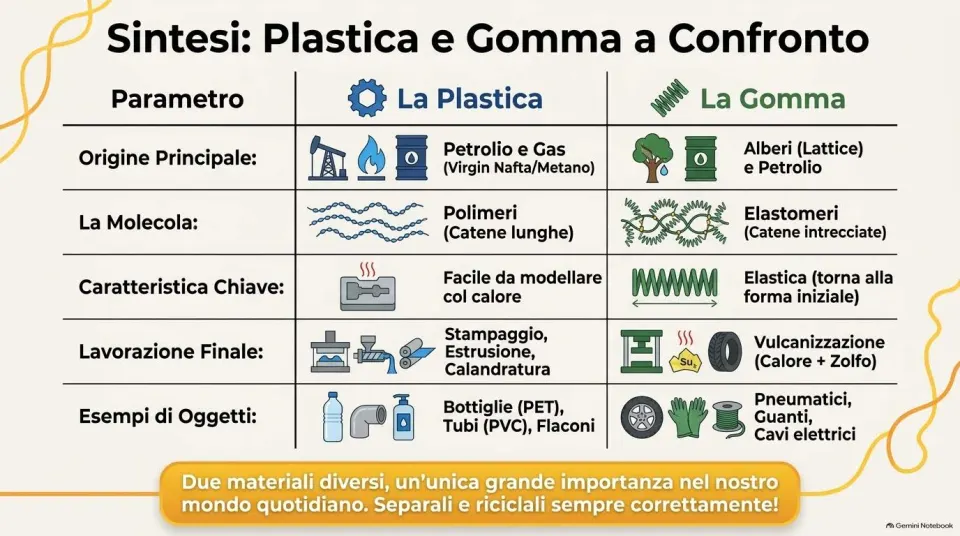
Like plastics, rubbers are also made of polymers. Their most important characteristic, however, is elasticity.
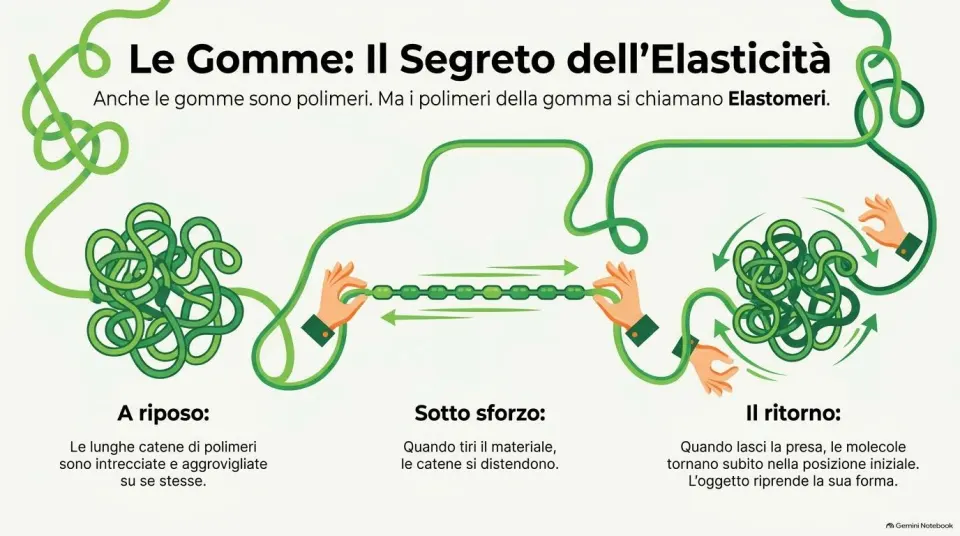
Inside rubber, the long polymer chains are tangled and folded. When the material is pulled, these chains stretch out. When the force stops acting, the molecules tend to return to their initial position and the object recovers its shape.
For this reason elastic polymers are called elastomers.
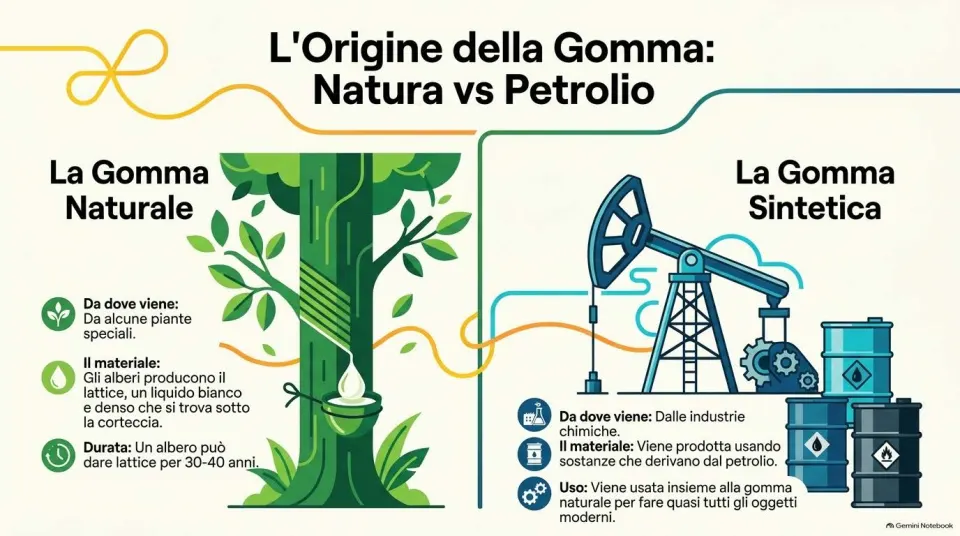
Rubbers can be divided into natural rubber, obtained from certain plants, and synthetic rubber, produced mainly from substances derived from petroleum.
Italiano
Anche le gomme, come le plastiche, sono formate da polimeri. La loro caratteristica più importante è però l'elasticità.
All'interno della gomma le lunghe catene di polimeri sono intrecciate e ripiegate. Quando il materiale viene tirato, queste catene si distendono. Quando la forza smette di agire, le molecole tendono a tornare nella posizione iniziale e l'oggetto recupera la propria forma.
Per questo motivo i polimeri elastici vengono chiamati elastomeri.
Le gomme possono essere suddivise in gomma naturale, ottenuta da alcune piante, e gomma sintetica, prodotta principalmente utilizzando sostanze derivate dal petrolio.
Natural rubber
Natural rubber is obtained above all from certain plants that produce latex, a whitish, thick and viscous liquid found in the tissues under the bark. A tree used for rubber production can continue to supply latex for about 30–40 years.
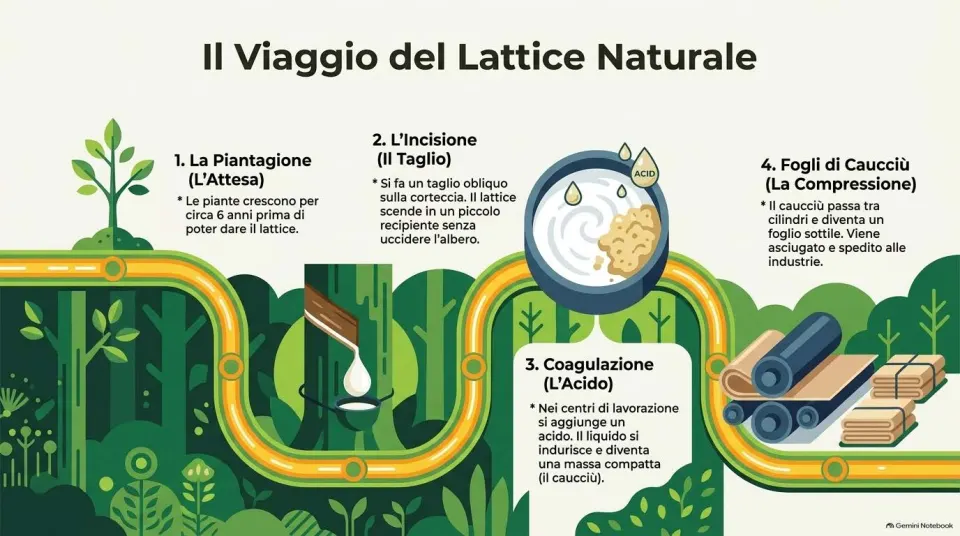
The plantation
The young plants are first grown in a nursery and then moved to the plantations. Preparing the areas for cultivation may involve clearing forests and working the soil. The trees must grow for several years before they can be used. Generally it is necessary to wait about six years before starting to collect the latex.
Tapping
When the plant is sufficiently developed, a slanting cut is made in the bark. The latex slowly flows out of the wound and is directed, through a small spout, into a container placed on the trunk. In this way the liquid can be collected without cutting down the tree.
Collection and coagulation
When the containers are full, the latex is taken to the processing centres. Here an acidic substance is added, which causes the coagulation of the caoutchouc contained in the latex. Coagulating means that the particles dispersed in the liquid join together, forming a more compact mass.
Forming the sheets
The caoutchouc obtained is passed between rollers that press it and turn it into thin sheets. The sheets are then left to dry, grouped into bales and sent to the industries that will produce rubber objects.
Italiano
La gomma naturale
La gomma naturale viene ricavata soprattutto da alcune piante che producono lattice, un liquido biancastro, denso e viscoso presente nei tessuti situati sotto la corteccia. Un albero destinato alla produzione di gomma può continuare a fornire lattice per circa 30-40 anni.
La piantagione
Le giovani piante vengono inizialmente coltivate in vivaio e poi trasferite nelle piantagioni. La preparazione delle aree destinate alla coltivazione può comportare il disboscamento e la lavorazione del terreno. Gli alberi devono crescere per diversi anni prima di poter essere utilizzati. In genere è necessario attendere circa sei anni prima di iniziare la raccolta del lattice.
L'incisione
Quando la pianta è sufficientemente sviluppata, sulla corteccia viene praticato un taglio obliquo. Il lattice fuoriesce lentamente dalla ferita e viene indirizzato, attraverso un piccolo beccuccio, verso un recipiente collocato sul tronco. In questo modo il liquido può essere raccolto senza abbattere l'albero.
Raccolta e coagulazione
Quando i contenitori sono pieni, il lattice viene trasferito nei centri di lavorazione. Qui viene aggiunta una sostanza acida che provoca la coagulazione del caucciù presente nel lattice. Coagulare significa che le particelle disperse nel liquido si uniscono tra loro formando una massa più compatta.
Formazione dei fogli
Il caucciù ottenuto viene fatto passare tra alcuni cilindri che lo comprimono e lo trasformano in fogli sottili. I fogli vengono poi lasciati asciugare, raggruppati in balle e spediti alle industrie che produrranno gli oggetti in gomma.
The production of rubber objects
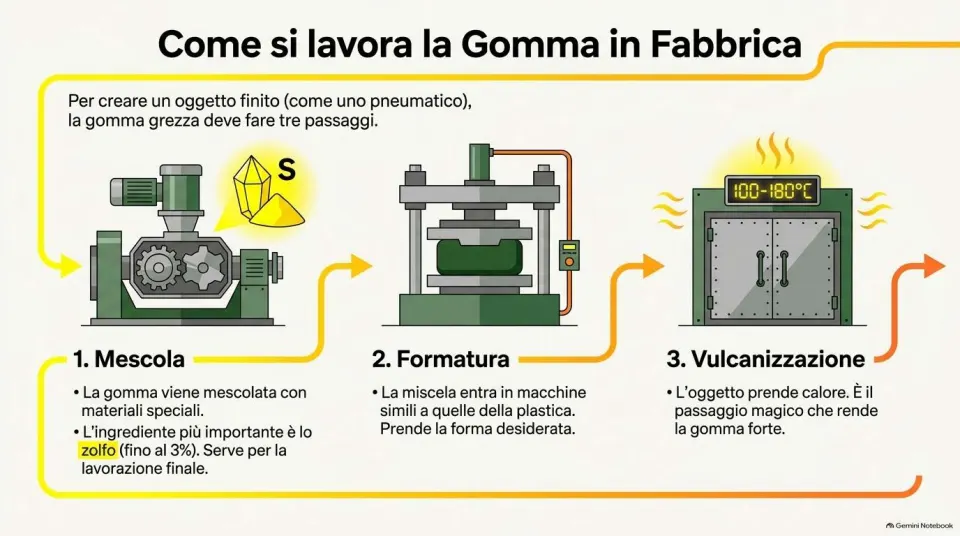
Industry uses both natural and synthetic rubbers. To turn the raw material into a finished product, three main processes are carried out: mixing, forming and vulcanisation.
Mixing
The rubber is mixed with other substances that modify and improve its characteristics. Fillers, antioxidants and sulphur can be added, the latter generally up to about 3%. In this way a mixture is obtained with the characteristics suitable for the following processes.
Forming
The mixture is fed into machines similar to those used to process plastics. The rubber is shaped until it takes on the desired form, and so an object is obtained whose dimensions and surface are already defined.
Italiano
La produzione degli oggetti in gomma
Nelle industrie vengono utilizzate sia gomme naturali sia gomme sintetiche. Per trasformare la materia prima in un prodotto finito si effettuano principalmente tre lavorazioni: mescola, formatura e vulcanizzazione.
Mescola
La gomma viene mescolata con altre sostanze che servono a modificarne e migliorarne le caratteristiche. Possono essere aggiunti materiali di carica, antiossidanti e zolfo, generalmente fino a circa il 3%. Si ottiene così una miscela con le caratteristiche adatte alle successive lavorazioni.
Formatura
La mescola viene introdotta in macchine simili a quelle utilizzate per lavorare le materie plastiche. La gomma viene modellata fino ad assumere la forma desiderata e si ottiene così un oggetto già definito nelle sue dimensioni e nella sua superficie.
Vulcanisation
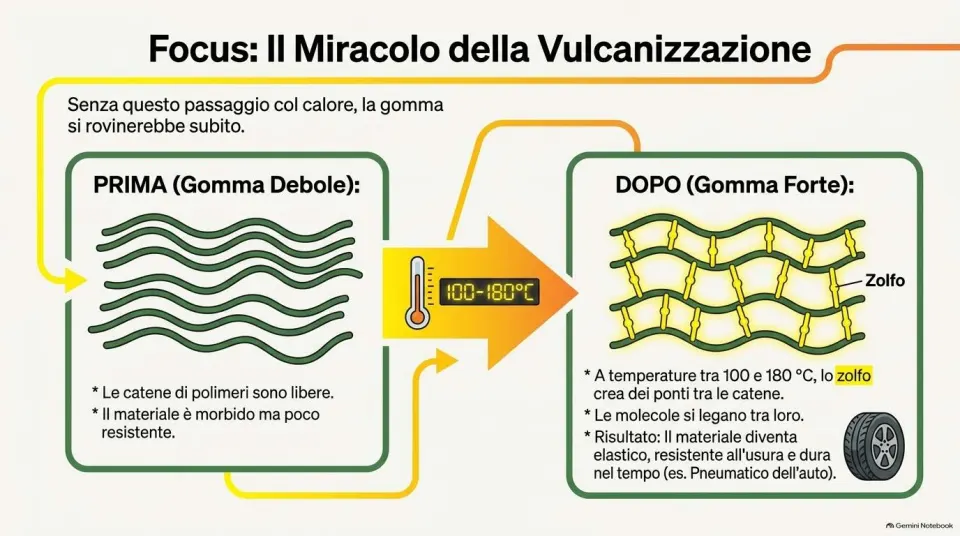
The last phase is vulcanisation. The rubber object is heated to temperatures roughly between 100 and 180 °C. The treatment can last from a few minutes to several hours, depending on the product. During heating, the sulphur creates links between the rubber molecules. Thanks to vulcanisation the material becomes more elastic, resistant to wear and long-lasting.
Italiano
Vulcanizzazione
L'ultima fase è la vulcanizzazione. L'oggetto in gomma viene riscaldato a temperature comprese indicativamente tra 100 e 180 °C. Il trattamento può durare da pochi minuti fino ad alcune ore, a seconda del prodotto. Durante il riscaldamento lo zolfo crea dei collegamenti tra le molecole della gomma. Grazie alla vulcanizzazione il materiale diventa più elastico, resistente all'usura e durevole nel tempo.
Uses of rubber
One of the main uses of rubber is the production of tyres, but this material is also used in many other sectors. It is used, for example, for covering and insulating electric cables, for irrigation hoses, for seals and other technical components. Latex is also used to produce gloves for healthcare or household use. All these products mainly exploit the elasticity, flexibility and ability of rubber to resist deformation and wear.
Italiano
Gli impieghi della gomma
Uno dei principali utilizzi della gomma è la produzione degli pneumatici, ma questo materiale trova applicazione anche in molti altri settori. Viene utilizzato, per esempio, per il rivestimento e l'isolamento dei cavi elettrici, per i tubi destinati all'irrigazione, per guarnizioni e altri componenti tecnici. Il lattice viene inoltre impiegato per la produzione di guanti utilizzati in ambito sanitario oppure domestico. In tutti questi prodotti vengono sfruttate soprattutto l'elasticità, la flessibilità e la capacità della gomma di resistere alle deformazioni e all'usura.