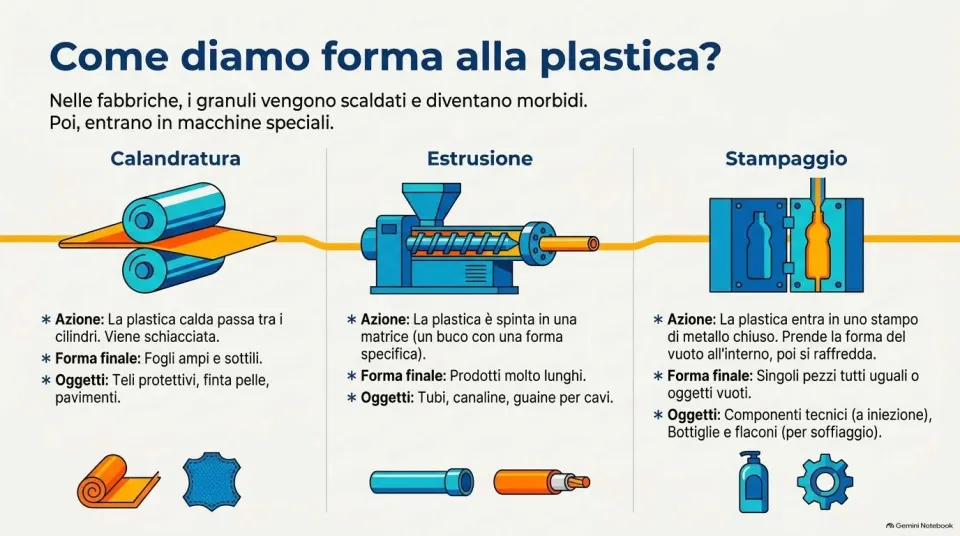
In factories, the granules are heated until they turn into a soft mass that can be shaped. This material can then be processed with specific machines to obtain products of very different shapes and sizes. One of the main advantages of plastic compared with materials such as metals is precisely how easily it can be shaped. In a short time it is possible to obtain objects that are already very close to their final shape.
Calendering
Calendering is used to produce large, thin surfaces. The heated plastic passes through a series of rollers that press it until it reaches the desired thickness. With this technique it is possible to make, for example, plastic sheets, panels, floor coverings, protective sheeting and synthetic materials similar to leather used for upholstery and furnishings.
Extrusion
Extrusion makes it possible to obtain very long products that always keep the same cross-section. The heated plastic material is pushed through a die, that is, an opening that has the shape of the cross-section of the product to be made. If the die has, for example, a circular shape with an empty part in the centre, a pipe can come out of the machine. The product is formed continuously, then cooled and finally cut or rolled up and packaged. This technique is used above all to produce pipes, profiles, cable ducts, sheaths and other long elements with a constant cross-section.
Moulding
Moulding is used to make single pieces, often produced in large quantities and all identical. The shape of the object is contained inside a mould, normally made of two or more metal parts. When the mould is closed, a cavity with the same shape as the product to be obtained remains inside it. The plastic is heated until it becomes soft and is then introduced or pushed into the cavity. After cooling, the mould is opened and the piece is removed. There are different types of moulding. Injection moulding, for example, is used for many technical components, household objects and parts of household appliances. Blow moulding, on the other hand, is particularly suitable for producing objects that are hollow inside, such as bottles and flasks.
Italiano
Nelle fabbriche i granuli vengono riscaldati fino a trasformarsi in una massa morbida e modellabile. Questo materiale può poi essere lavorato con macchine specifiche per ottenere prodotti di forme e dimensioni molto diverse. Uno dei principali vantaggi della plastica rispetto a materiali come i metalli è proprio la facilità con cui può essere modellata. In poco tempo è possibile ottenere oggetti già molto vicini alla loro forma definitiva.
Calandratura
La calandratura viene utilizzata per produrre superfici ampie e sottili. La plastica riscaldata passa attraverso una serie di cilindri che la comprimono fino a raggiungere lo spessore desiderato. Con questa tecnica si possono realizzare, per esempio, fogli di plastica, lastre, rivestimenti per pavimenti, teli protettivi e materiali sintetici simili alla pelle utilizzati per rivestimenti e arredamento.
Estrusione
L'estrusione permette di ottenere prodotti molto lunghi che mantengono sempre la stessa sezione. Il materiale plastico riscaldato viene spinto attraverso una matrice, cioè un'apertura che possiede la forma della sezione del prodotto da realizzare. Se la matrice ha, per esempio, una forma circolare con una parte vuota al centro, dalla macchina può uscire un tubo. Il prodotto viene formato in modo continuo, poi raffreddato e infine tagliato oppure avvolto e confezionato. Questa tecnica viene utilizzata per produrre soprattutto tubi, profili, canaline, guaine e altri elementi lunghi a sezione costante.
Stampaggio
Lo stampaggio viene utilizzato per realizzare singoli pezzi, spesso prodotti in grandi quantità e tutti uguali. La forma dell'oggetto è contenuta all'interno di uno stampo, normalmente costituito da due o più parti metalliche. Quando lo stampo viene chiuso, al suo interno rimane una cavità con la stessa forma del prodotto che si vuole ottenere. La plastica viene riscaldata fino a diventare morbida e poi viene introdotta o spinta nella cavità. Dopo il raffreddamento, lo stampo viene aperto e il pezzo viene estratto. Esistono diversi tipi di stampaggio. Lo stampaggio a iniezione, per esempio, viene utilizzato per molti componenti tecnici, oggetti domestici e parti di elettrodomestici. Lo stampaggio per soffiaggio è invece particolarmente adatto alla produzione di oggetti vuoti all'interno, come bottiglie e flaconi.