Mechanical properties define how a material behaves when it is subjected to external stresses. If, for example, we try to bend two strips half a centimetre thick with the same force, one made of wood and one made of iron, we notice that the wooden one bends and the iron one does not. There are five simple stresses that can deform or break a material, and they can also act together. For example, the trunk of a tree is subjected to compression because of the weight of its crown and, when the wind blows, also to bending.
The simple stresses:
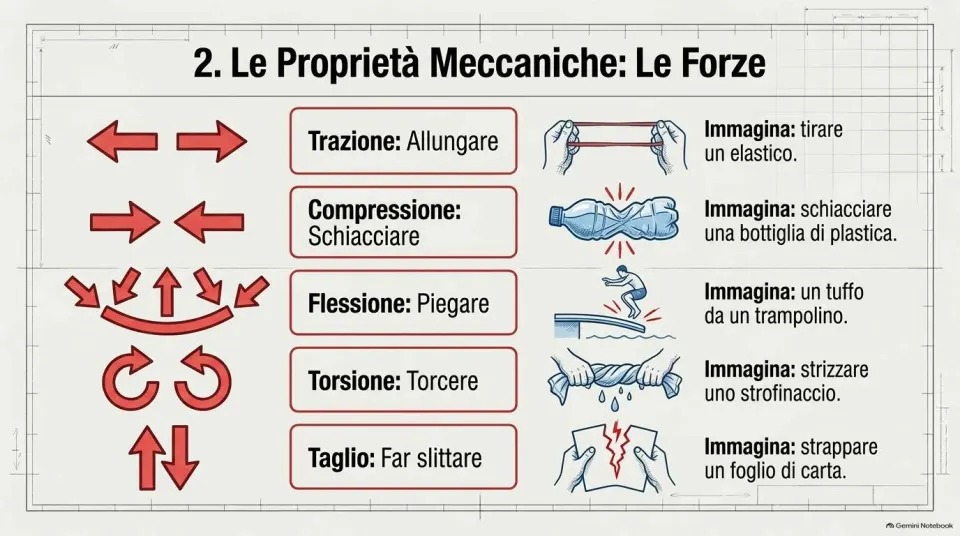
- Tension tends to stretch the material (imagine, for example, pulling a rubber band).
- Compression tends to squeeze a material (imagine, for example, crushing a bottle).
- Bending tends to bend the material (imagine, for example, diving from a springboard).
- Torsion tends to twist a material (imagine, for example, wringing out a cloth).
- Shear tends to make two neighbouring planes of a material slide over each other (imagine, for example, tearing a sheet of paper).
Depending on how a material behaves when it is subjected to a stress, the following mechanical properties can be identified.
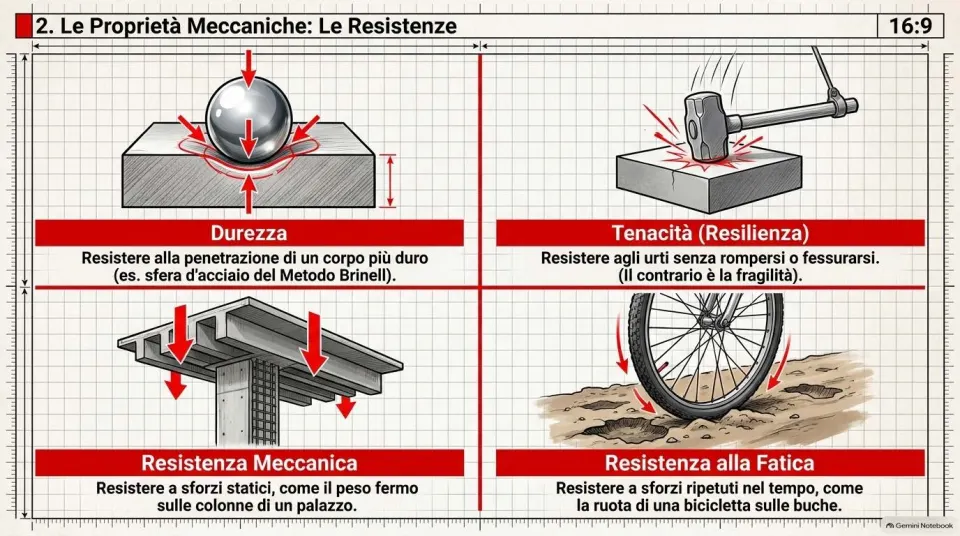
- Hardness: it is the ability of a material to resist penetration by another, harder body. For example, a drill bit must be harder than the material it has to drill.
- Toughness or resilience: it is the ability of a material to withstand impacts without breaking. For example, a protective helmet must be made of materials able to absorb impacts.
- Mechanical strength: it is the ability of a material to withstand static loads. For example, a column must be able to support the weight of the structure above it.
- Fatigue resistance: it is the ability to withstand repeated stresses over time. For example, a spring is continuously compressed and released without breaking.
Italiano
Le proprietà meccaniche definiscono il comportamento di un materiale sottoposto a sollecitazioni esterne. Se, per esempio, proviamo a piegare con la stessa forza due listelli spessi mezzo centimetro, uno di legno e uno di ferro, notiamo che quello di legno si flette e quello di ferro no. Le sollecitazioni semplici, che possono deformare o rompere un materiale, sono cinque e possono agire anche insieme. Per esempio, il tronco di un albero è sottoposto a compressione per il peso della sua chioma e, se tira vento, anche a flessione.
Le sollecitazioni semplici:
- La trazione, tende ad allungare il materiale (immagina, per esempio, mentre tiri un elastico).
- La compressione, tende a comprimere un materiale (immagina, per esempio, di schiacciare una bottiglia)
- La flessione, tende a piegare il materiale (immagina, per esempio, di fare un tuffo da un trampolino)
- La torsione, tende a torcere un materiale (immagina, per esempio, di strizzare uno strofinaccio)
- Il taglio, tende a far slittare l'uno sull'altro due piani vicini di un materiale. (immagina, per esempio, quando strappi un foglio di carta)
Depending on how a material behaves when it is subjected to a stress, the following mechanical properties can be identified.
- Hardness: it is the ability of a material to resist penetration by another, harder body. For example, a drill bit must be harder than the material it has to drill.
- Toughness: it is the ability of a material to withstand impacts without breaking. For example, a protective helmet must be made of materials able to absorb impacts.
- Mechanical strength: it is the ability of a material to withstand static loads. For example, a column must be able to support the weight of the structure above it.
- Fatigue resistance: it is the ability to withstand repeated stresses over time. For example, a spring is continuously compressed and released without breaking.
Italiano
In base al comportamento del materiale quando è sottoposto a una sollecitazione, si possono individuare le seguenti proprietà meccaniche.
- Durezza: è la capacità di un materiale di resistere alla penetrazione di un altro corpo più duro. Per esempio, la punta di un trapano deve essere più dura del materiale che deve forare.
- Tenacità: è la capacità di un materiale di resistere agli urti senza rompersi. Per esempio, un casco protettivo deve essere realizzato con materiali capaci di assorbire gli urti.
- Resistenza meccanica: è la capacità di un materiale di resistere a sforzi statici. Per esempio, una colonna deve essere in grado di sostenere il peso della struttura che si trova sopra di essa.
- Resistenza alla fatica: è la capacità di resistere a sforzi ripetuti nel tempo. Per esempio, una molla viene sottoposta continuamente a compressioni e distensioni senza rompersi.